The Science Has a Name. Japan Had a Gentle Answer, Centuries Ago.
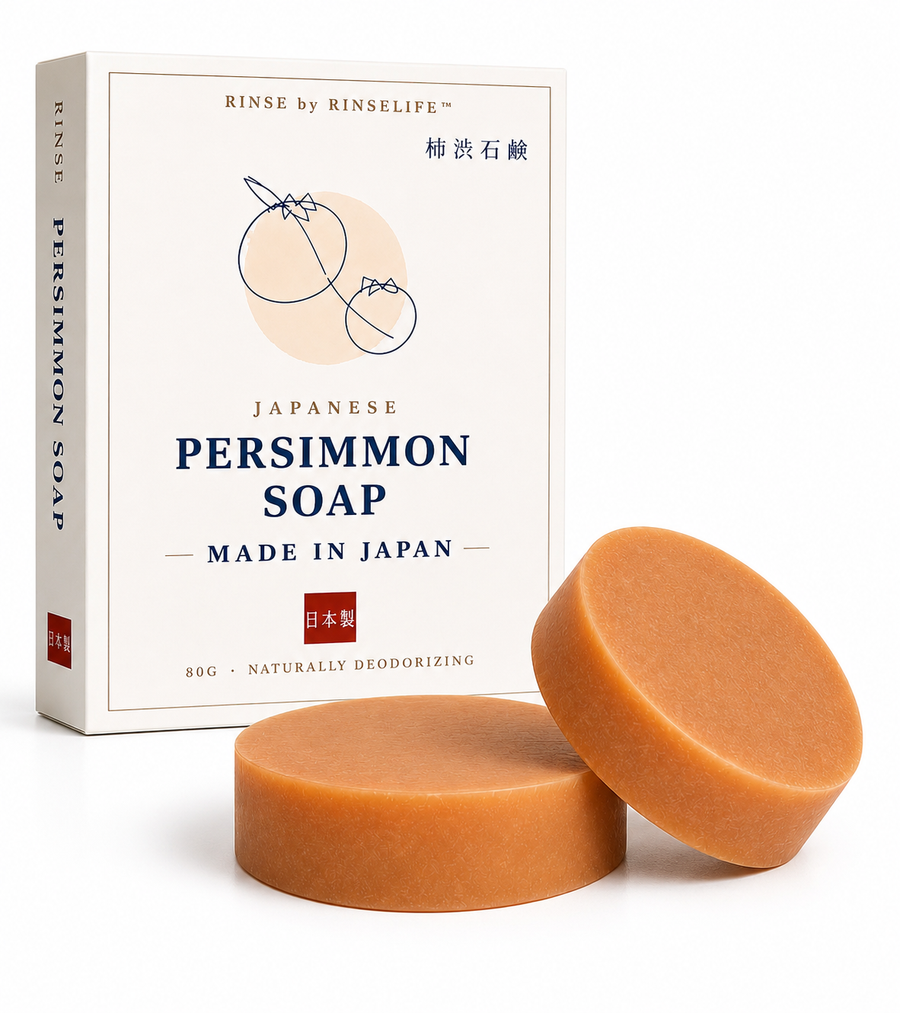
After 40, skin chemistry changes in a way that creates a distinct scent researchers call 2-nonenal. It's not about hygiene — it's biology. Kakishibu, a traditional Japanese persimmon soap, has been part of the answer for generations.
A tradition older than modern chemistry.
Long before synthetic deodorizers, Japanese households relied on fermented persimmon tannin for its natural freshening properties. We still make it the same way.
What most soap leaves out
Many soaps rely on synthetic fragrance to mask odor rather than natural ingredients that help skin feel genuinely fresh.
800+ years of kakishibu
Fermented persimmon tannin has been used in Japan since the Heian period — on textiles, paper, and skin.
Naturally deodorizing
A gentle, traditional recipe that helps skin feel clean and fresh — no synthetic antibacterial claims, just a process trusted for centuries.
It has a name: 2-nonenal.
In 2001, researchers at Shiseido's Tokyo research center identified a specific compound present almost exclusively in adults 40 and older — now understood as a marker of skin's natural aging process, not a hygiene issue.
As skin ages, a fatty acid called palmitoleic acid increases on the skin's surface, while the skin's natural antioxidant defenses gradually decline.
This isn't surface residue — it's an ongoing chemical process in the skin itself, which is part of why it can feel harder to fully address with an ordinary wash.
This happens to people who shower daily. It's a biological shift, not a reflection of cleanliness.
I didn't know it was a chemical change. I thought she just needed more showers.
Made in Japan — the ingredient and the soap.
Kakishibu, fermented persimmon tannin, has been part of Japanese daily life for over 800 years. Rinse is manufactured in Japan using a traditional cold-process recipe — not just sourced with a Japanese ingredient and made elsewhere.
My husband showers every day, but I didn't know how to bring it up. I just quietly switched his soap. He says his skin feels better than it has in years.
“Placeholder review text — started using it as a precaution before I noticed anything.”
“Placeholder review text — my skin feels softer, not stripped.”
“Placeholder review text — I care for my mother and wanted something gentle.”
Sourced from Japan is not the same as made in Japan.
Try it with confidence.
60 days to see if Rinse belongs in your routine — or your family's. If it's not right, a full refund, no questions asked.
Quick questions.
Is it really made in Japan?
Yes — both the persimmon tannin and the soap itself are made in Japan, using a traditional cold-process recipe. Many competing brands only source the ingredient from Japan while manufacturing elsewhere.
What is 2-nonenal, exactly?
It's a compound identified by Shiseido researchers in 2001, found almost exclusively in adults 40 and older. It forms from natural changes in skin lipids as antioxidant defenses decline with age — a biological process, not a hygiene issue.
Does this soap help with it?
Kakishibu has been traditionally used in Japan for centuries for its natural deodorizing properties, as part of a regular washing routine. We don't make clinical claims — we make an honest, traditional product with a long history of use.
Is it gentle enough for mature or sensitive skin?
Our recipe uses traditional, minimal ingredients. As with any new product, we recommend a small patch test first if you have particularly sensitive skin.
What if it's not right for us?
You're covered by our 60-day money-back guarantee — a full refund, no questions asked.